If a scaffold erector decided to get on a train to attend a class addressing scaffold hazards and erection techniques, would he have been trained by the time he got there?
What if he got off the train and then got back on; would that be retraining?
Perhaps I have lost my train of thought. What has this got to do with scaffolding or training? The short answer is – nothing. However, now that I have your attention, let’s talk about training.

Training is a short-term, practical, and task-oriented process focused on acquiring specific skills or competencies for a particular job. Training is commonly used to develop a specific skill or skills necessary to perform a certain task, such as using or erecting scaffolds.
Employers regularly utilize training to help employees recognize and mitigate jobsite hazards, increase productivity, learn a new job, and comply with applicable regulations and laws. In fact, training is so essential to the business of scaffolding that the business cannot exist without training. Scaffold erectors require training so they can construct safe scaffolds. Inspectors require training so they can identify scaffold deficiencies and scaffold users require training so that they can safely use scaffolds.
The Scaffold and Access Industry Association, SAIA, has long recognized the importance of providing hazardawareness expertise for employers and employees. Since its founding, the SAIA has been developing valuable training resources, including codes of safe practices, technical bulletins, toolbox topics, standards, videos, and training programs. The SAIA is not alone in recognizing the value of training.
The US federal Occupational Safety & Health Administration (OSHA) recognized at its inception in 1970 that training needed to be a critical component of its safety program. So, it included training in the original promulgation of the
regulations. For example, Subpart C, General Safety and Health Provisions, of the Construction Industry regulations, specifies that employers are to “instruct each employee in the recognition and avoidance of unsafe conditions and the regulations applicable to his/her work environment to control or eliminate any hazards or other exposure to illness or injury.”
OSHA identified its expectations for scaffold training when it issued revised
scaffold regulations in 1996. At the time the revised scaffold regulations were
promulgated, OSHA opined that “it was appropriate to provide more specific
direction regarding the training necessary for employees who work on scaffolds”. OSHA’s specific direction included topics for scaffold user training, scaffold erector and inspector training, and retraining
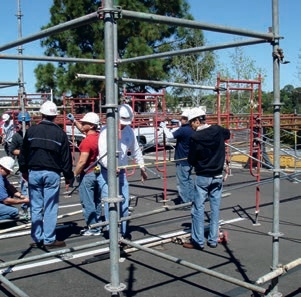
User training includes the nature of any electrical hazards, fall hazards, and falling object hazards; the correct procedures for dealing with electrical hazards and for erecting, maintaining, and disassembling the fall protection systems and falling object protection systems being used. Topics also include the proper use of the scaffold, and the proper handling of materials on the scaffold, the maximum intended load that will be placed on the scaffold, and the load-carrying capacities of the scaffolds that are being used. Finally, the employer is expected to provide training in any other pertinent requirements of the OSHA regulations.
Training for scaffold erectors and inspectors is more extensive since it not only includes the user training topics but also includes such topics as the correct procedure for erecting scaffolds, scaffold design criteria, and inspection criteria.
The training regulations wrap up with retraining requirements. Retraining regulations essentially address employees who forget their training, are exposed to hazards about which an employee has not been trained, and where changes to the type of scaffold or other equipment present hazards that the employee has not been trained to recognize.
Training can be provided in multiple formats and time frames, utilizing the plethora of information that is available from the SAIA and OSHA. The training must be conveyed in a manner that is effective; training is only successful if the recipient understands the information being presented. If that can be done through the use of a manual, so be it. On the other hand, if the employees cannot read or write, a manual is useless. Likewise, conducting training in English to a group of French-speaking scaffold erectors will probably not be an effective strategy.
Questions are frequently asked regarding the time it takes to do the training. The simple answer is that the length of the training is dependent on the amount of information being taught. It can be presented in as little as 5 minutes or over several days, months or years. Importantly, time does not equate knowledge gained. In other words, training is all about quality, not quantity.
Certificates are typically issued to indicate employees have invested the time in obtaining job-enhancing knowledge and that they have completed training. While a certificate is not a substitute for being able to apply the knowledge gained through the training, it is a valuable document for employees to possess and is a record of their training.
The SAIA has readily accessible information on its website that can be used to train scaffold users, erectors, inspectors, and others involved with scaffolding. The SAIA also has Accredited Training Institutes which can provide specific scaffold training. These specialized classes are carefully designed for users of scaffold and access equipment ensuring that participants are well-informed about essential safety aspects.
The SAIA training offers a comprehensive educational experience through a combination of presentations, interactive question-and-answer sessions, hands-on activities, and a final assessment to reinforce learning and practical application. Similarly, OSHA also has materials that can be used in developing training programs and curricula. In addition, OSHA and its Education Centers also offer employee training.
The business of scaffolding is one of exciting opportunities. While it may be perceived as a dangerous enterprise, the reality is quite different, once the hazards are known. One fascinating aspect of training is that it teaches awareness of unknown hazards. As former US Defense Secretary Donald Rumsfeld infamously stated: “But there are also unknown unknowns – the ones we don’t know we don’t know.” Seek out training and get to know the unknown unknowns