After 10 years as a volunteer firefighter, Becky Danielson has spent the past two decades teaching fall protection and rescue techniques across some of America’s most dangerous industries. As chair of SAIA’s Fall Protection Council and builder of Safewaze’s training academy, she’s proving that the best safety instruction comes from those who’ve faced life-and-death situations themselves. S&A Magazine sat down with Danielson during SAIA’s Committee Week to learn about her journey from the The fireground to the forefront of fall-protection education
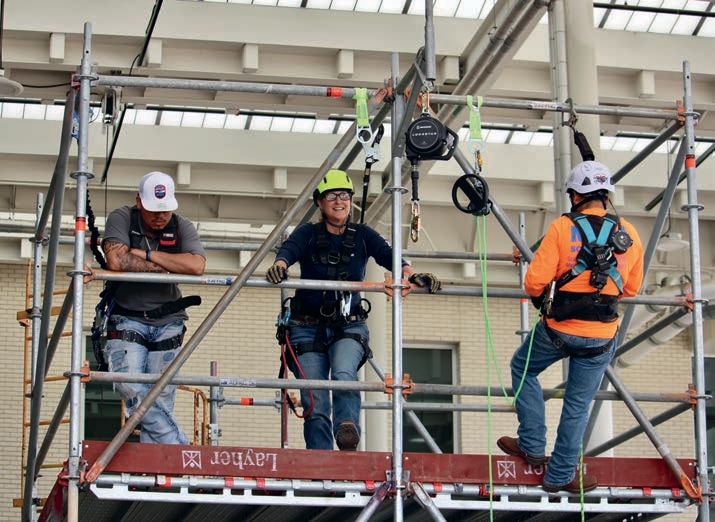
When Becky Danielson walks into a classroom full of skeptical workers, she knows she has about 10 minutes to win them over. As a woman in the maledominated fields of firefighting and fall protection, she’s faced dismissive attitudes more times than she can count. But two decades of expertise in rescue training, combined with a calm, knowledgeable teaching style, tends to change minds quickly. “It’s not easy,” Danielson admits. “I’ve had people in classes who are dismissive at first. But usually within about 10 minutes, once they see that I know what I’m talking about and I’ relaxed about it, they come around.”
That expertise didn’t develop overnight. Danielson spent 10 years as a firefighter before being recruited into the fall-protection industry 20 years ago while working at a hospital. She helped build a training program at a local company and never looked back, focusing her career on education and rescue training across wind energy, telecommunications, construction, and oil and gas sectors.
BUILDING AN ACADEMY FROM THE GROUND UP
A little over a year ago, Danielson joined Safewaze with a mission: build and run a comprehensive training academy. The numbers speak to her success. Between May and November of last year alone, she taught 144 students, developing tailored programs for industries ranging from construction to aggregate mining.
“I learned a lot working with the aggregate mining team,” she says. “They had unique situations and applications, and they fall under different standards. I did a lot with MSHA years ago, but I had to refresh my knowledge to make sure I was current and could provide them with the right solutions.”
That commitment to staying current isn’t just professional pride, it’s a matter of life and death. Danielson recalls a moment when her training quite literally saved someone’s life. Quite a few years ago at a tower site, a crew member dropped a socket while working at height. Thanks to tool tethering training Danielson had insisted upon, the tool was secured and didn’t strike a bystander below. The crew credited her emphasis on tethering during training with preventing a potentially fatal incident.
“When something like that happens, it reminds you why we do this work,” she says.
HAZARD MITIGATION BEFORE PPE
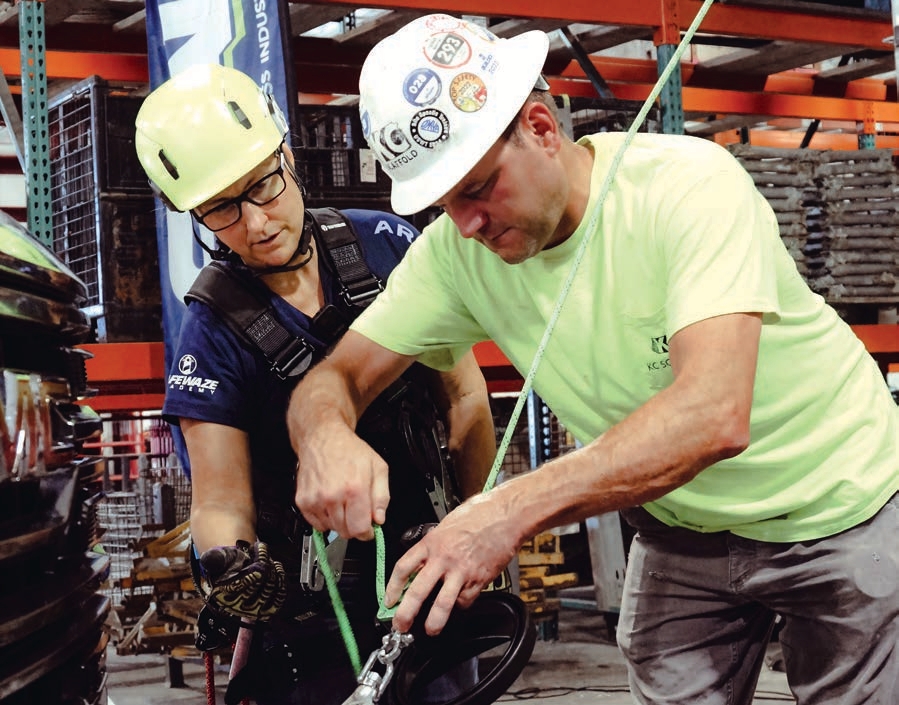
Danielson’s approach to fall protection follows the hierarchy of controls, emphasizing hazard mitigation before relying on personal protective equipment. She uses the example of hydraulically lowering street lights to perform maintenance at ground level, eliminating the fall hazard entirely rather than managing it at height.
“Can you mitigate the hazard? Can you do the work on the ground instead?” she asks. “That’s always the first question. Before we talk about what harness or what lanyard, we need to talk about whether someone needs to be up there at all.”
When work at height is unavoidable, Danielson stresses understanding fall forces and clearance calculations to choose the right equipment. Standards and manufacturer guidance change regularly, so staying current is essential.
BRINGING RESCUE TRAINING TO THE FIELD
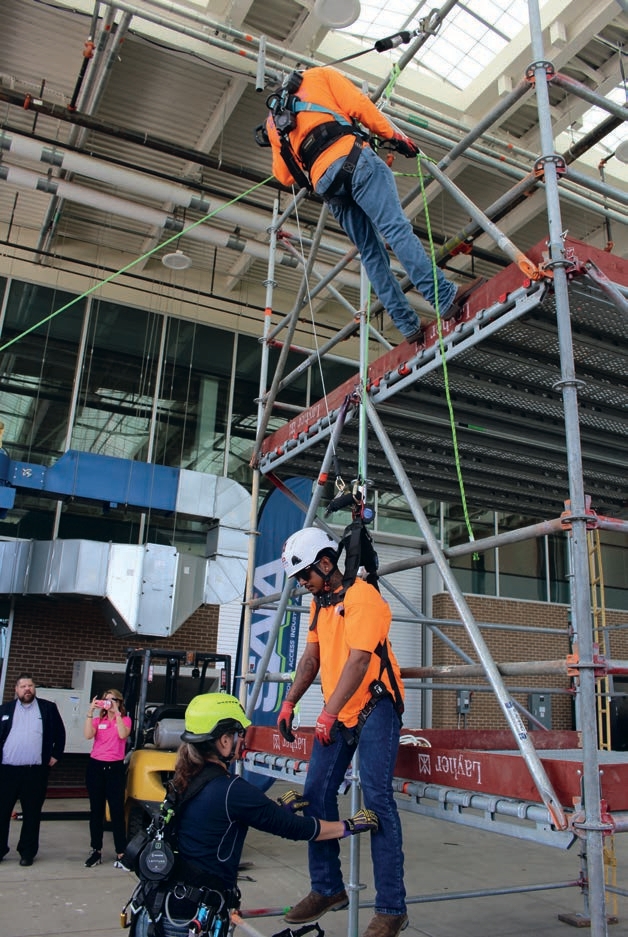
As chair of SAIA’s Fall Protection Council, Danielson collaborates with SAIA’s Christina Reed to plan and deliver rescue demonstrations nationwide. Last year alone, they completed seven rescue demos across the country, from Fort Worth, Texas, to New Jersey, Cincinnati, Ohio, and Kansas City. Two of those demos occurred in the same week. Five more are scheduled for this year.
The timing couldn’t be more relevant. OSHA’s increasing emphasis on prompt rescue requirements has made rescue planning central to fall-protection programs. Under OSHA requirements, employers must either provide prompt rescue in the event of a fall or ensure workers have the capability to rescue themselves.
“OSHA’s focus on prompt rescue has really changed the conversation,” Danielson notes. “It’s not enough to prevent the fall anymore.
You have to have a plan for what happens if someone is suspended.” The rescue demos themselves have evolved from static presentations to interactive working sessions. Danielson and her committee shifted from traditional lectures to field-driven discussions, creating stations where participants can engage hands-on with equipment and scenarios. This year’s Committee Week session featured an Olympic-themed challenge with gold, silver, and bronze levels to spark conversations about forces, clearance, and choosing the right tool for the job.
“We moved away from just standing up and presenting,” she says. “Now we have interactive stations based on what people are actually seeing in the field. That’s where real learning happens, where people can ask questions about their
specific situations.”
This shift in approach has proven so successful that it spawned a multi-session webinar series on equipment inspection, which in turn led to more rescue demos based on needs identified in the field.
RECOGNITION AND RESPONSIBILITY
Danielson’s leadership hasn’t gone unnoticed. She’s received both the Outstanding Chairperson award and the Spirit Award from the SAIA, recognition that visibly moved her when she discussed it.
“I was really honored,” she says, her emotion evident. “I feel like I’m just doing what I’m supposed to do, contributing a tiny part to something much bigger. SAIA has such a unique culture.”
That culture, according to Danielson, is what sets SAIA apart from other trade associations. Despite growing, the organization has maintained its close-knit community feel and continues to amplify voices from the field rather than becoming just another generic association with trade shows.
“They’ve done a really good job of staying unique,” she observes. “They still hear everybody’s voice. You get to some associations that have gotten so big that they just become another trade show. SAIA has meaningful discussions that drive learning and improvement. They even think about programming for spouses and plus-ones so people can bring their families. It’s very rare.”
Despite her extensive experience, Danielson maintains that she learns something new every single day, usually from her students.
“I’m not in every industry. I can’t be everywhere all the time,” she says. “So I learn things from people constantly, usually about the industries they work in. Sometimes they’ve run across a situation where they came up with a solution I’ve never heard of. It’s really cool to be able to learn from everybody.”
She pauses, then adds: “I always say the day I stop learning is the day I’m six feet under.”
SPEAKING UP, NO MATTER WHAT
Danielson’s commitment to safety extends beyond the classroom. Like an off-duty EMT who encounters a medical emergency, she feels obligated to intervene when she sees unsafe work practices on job sites. She follows a ‘see something, say
something’ approach and documents every intervention to ensure accountability.
It’s that sense of responsibility, to her students, to the industry, to the workers whose lives depend on proper training, that drives Danielson’s work.
From the fireground to the training ground, she’s spent 30 years in service to others. And she’s not slowing down. “I feel so honored to contribute,” she says. “Even if it is just a tiny part of what SAIA is building.”