From grinding scaffold in the Texas heat at 14 to becoming SAIA’s 28th President, Matt Morgan has spent his working life inside the industry. Now he wants the association judged by what it gets done, from apprenticeship and training to safer decisions on the jobsite
Matt Morgan was 14 when he started working around scaffolding. There was little glamour involved. He was grinding scaffold in the Texas summer heat, concentrating mainly on getting through the working day. More than three decades later, that experience still sits close to the surface.
“It taught me respect for work and, more importantly, respect for the people doing it,” Morgan says. “At 14, grinding scaffold in the Texas heat, you’re thinking about making it to the end of the day. I learned that every job matters and nobody is above work. That’s stayed with me.”
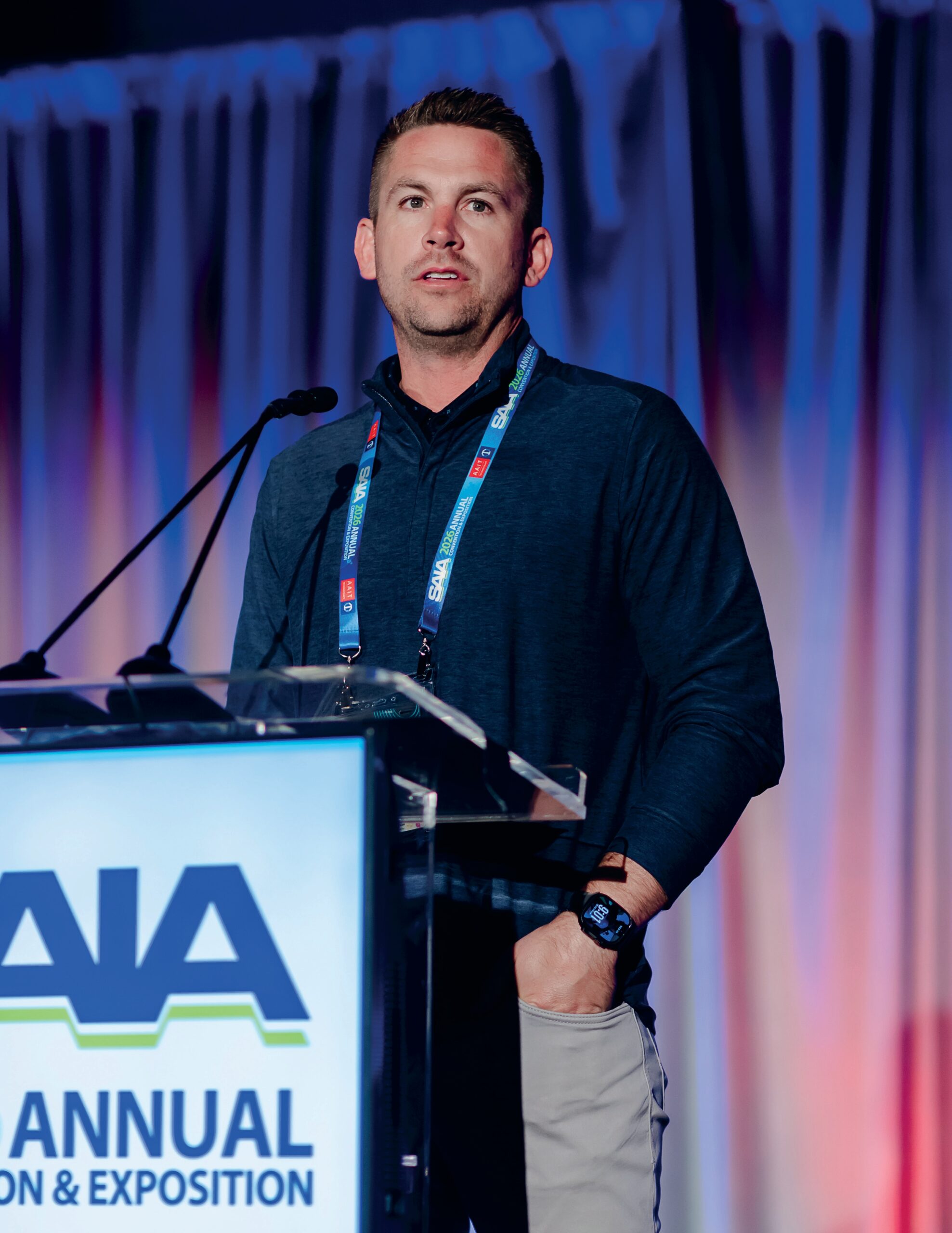
Today the decisions are different. Morgan is SAIA’s 28th President, sworn in during the closing President’s Gala at the Annual Convention & Exposition in Nashville, and the third president to come from the Action Scaffold family, where he is President at MDM Scaffolding in Hurst, Texas.
But he still thinks about the person expected to carry out a decision once the meeting ends.
“When we’re making decisions, I try to remember there is somebody in the yard or on a jobsite who has to execute what we’re talking about in the office,” he says.
“I expect a lot from our people, but I also believe leadership is earned. You have to be willing to
work, listen, and never forget where you started.”
That starting point may explain much of what Morgan wants from his two-year term. The priorities are familiar across construction: workforce shortages, training, changing equipment, and technology. His approach is heavily focused on execution.
A PRESIDENCY WITH A DEADLINE
Morgan took the oath in Nashville after serving on SAIA’s Executive Committee since 2016. The association already has its 2025–2027 Strategic Plan underway, alongside work on training programs,
standards, and a scaffold apprenticeship pathway.
His predecessor, Mike Bredl, left him with a fairly clear challenge: SAIA built more resources and expanded its training offer during his term, and the open question was whether they were being used consistently enough to change behavior in the field.
Morgan wants his own presidency measured just as practically. “For me, success in 2028 won’t be measured by how many things we started but what we accomplished and what is positioned to continue after my term is over,” he says.
Workforce development sits high on that list. So does greater participation in SAIA’s committees
and councils, particularly among younger professionals and people who have yet to take leadership roles within the association. He wants more companies to see SAIA as “a place where they can contribute, not simply an association they belong to”.
He also wants SAIA to draw more of the access sector into its work, including mast climbers and hoists, while reaching companies that may never have considered joining.
“There are a lot of subcontractors and GCs that don’t know about SAIA that we can reach out to and show the value of being involved,” he says.
His benchmark for 2028 is simple enough: “I don’t want initiatives that disappear when my presidency ends.”
“Over these next two years, I want us focused less on protecting what we’ve always done and more on
building what SAIA and our industry need for the next 10 years”
THE WORKFORCE COMES FIRST
During his Nashville speech, Morgan told members: “Every generation has faced change, and every generation has faced a choice: react or lead. Either way, our time is now.”
He defined what the phrase means in practice: “Over these next two years, I want us focused less on protecting what we’ve always done and more on building what SAIA and our industry need for the next 10 years.”
Asked which change demands the quickest response, he goes directly to labor. “The biggest change we have to make is our workforce,” he says. “We can have the best equipment, standards, and technology in the world, but if we aren’t attracting, training, and developing the next generation of people, none of it matters.”
Another pressure is building alongside it. The work itself is changing. Digital systems are
entering estimating and project management. Engineering is becoming more complex. Mast climbers, hoists, and other access equipment are taking a larger place in the sector. Training has to keep pace with what crews are being asked to do.
That brings Morgan back to something SAIA has been discussing for several years: a formal apprenticeship pathway for scaffold builders.
The project is already beyond its earliest stages. During Committee Week earlier this year, SAIA reported that a draft apprenticeship program had been submitted for review, with work under way to develop the teaching material required for Department of Labor certification.
The harder questions around implementation come next. “We need to move from the idea and research stage into determining what is actually feasible for SAIA and our members,” Morgan says. That includes understanding Department of
Labor requirements, securing employer participation, deciding what part SAIA should play in administering a program, and working out what resources will be required to sustain it.
He is blunt about the failure mode. “One thing I don’t want us to do is create a program that
looks good on paper but isn’t being used by our members.”
Employer participation will decide whether the idea succeeds. “We need something that works for the contractor trying to recruit and develop people just as much as it works from an education standpoint.”
By 2028, Morgan wants a defined pathway, committed employers, and the necessary relationships with organizations including the Department of Labor and OSHA. If the feasibility work supports it, he wants the program established and entering implementation.
His ambition reaches beyond the first job title. A person entering scaffolding should be able to see a route through the trade, from scaffold builder to competent person, foreman or supervisor. From there, the industry can open into training, safety, estimating, sales, operations, and company leadership.
Morgan has watched that happen throughout his own career.
“A lot of companies know first-hand that their best sales members come from the field,” he says, “and they make a great living in a position they may never have thought was possible.”
For a trade struggling to recruit younger people, he believes that story needs to be told much better.
RAISING THE FLOOR ON TRAINING
Workforce numbers are only part of the problem. Training quality varies widely between companies. Large contractors can invest in dedicated safety teams, facilities, and trainers. Smaller businesses often work with far fewer resources.
Morgan sees a clear role for SAIA in narrowing that gap.
“SAIA’s role should be to help raise the floor,” he says. “We need to make it easier for more companies and more workers to reach that standard.” That means training in more markets, more qualified instructors and practical resources that smaller companies can use.
“A smaller contractor may not have a full-time safety department or training facility, but their employees deserve access to the same quality education and safety standards.”
The case for training goes beyond compliance, he argues. “Good training affects safety, productivity, quality, retention, and ultimately the professionalism of our entire industry.”
The point matters because inconsistency carries risk. The scaffold crew on a project may change. Subcontractors work alongside different general contractors. Equipment moves between sites. Standards applied carefully by one company can be handled very differently by another.
He wants quality training treated as part of the job itself.
“We can establish a strong industry standard, make the resources available to achieve it and create an expectation that if you’re going to work in scaffold and access, quality training and safety aren’t optional.”
WHAT HAPPENS AFTER THE CERTIFICATE?
There is another part of the training question on Morgan’s list.
Attendance numbers are easy to count. So are tests passed and cards issued. The harder measurement happens after the worker gets back on the jobsite, and that is the point Morgan wants SAIA to get closer to.
“Ultimately the question is: are we changing behavior in the field and making our jobsites safer?” That means listening to contractors after training and examining what supervisors actually see. Are competent people better prepared? Is planning improving? Are incidents and near misses falling? Are crews applying what they were taught when the pressure of a live job takes over?
He also wants stronger feedback from trainers, safety professionals, and scaffold builders themselves.
“If something we’re teaching isn’t translating effectively to the jobsite, we need to know that and be willing to improve it.”
It picks up the discussion Bredl started before leaving office. Bredl argued that SAIA had improved the tools available to companies, yet still lacked a clear picture of how far those tools were changing behavior across the industry. Morgan is effectively setting that as one of the tests for his own term. “Training should be measured by whether people go home safer because of what they learned.”
“Technology is a tool. It doesn’t replace experience, engineering judgment, competent people, or accountability”
TECHNOLOGY STILL NEEDS A HUMAN CHECK
The same principle shapes Morgan’s view of AI and construction technology.
SAIA’s Nashville convention gave digital tools a prominent place, with sessions and demonstrations
covering AI, estimating, planning, design, and workforce management. Morgan expects the association to stay involved as those systems spread through the industry, but he draws the role narrowly. “Our role should be to provide guidance, education and best practices, not tell companies what technology they should or shouldn’t use.”
“AI and technology are moving incredibly fast, and they’re already changing how our industry estimates projects, creates designs, manages safety, trains employees, and communicates information from the office to the field.”
His boundary is clear. “Technology is a tool. It doesn’t replace experience, engineering judgment, competent people, or accountability.”
That becomes particularly important around scaffold design and safety decisions, where incorrect information can carry immediate consequences. “There still needs to be qualified human oversight and clear responsibility for the final decision.”
It matches a point made in this magazine earlier this year, when the growing use of AI in project records and compliance was paired with the need for a human check on design, loading, and safe work practices. Morgan wants SAIA to help members see where technology genuinely improves their work and where its limits sit.
BACK TO THE FIELD
Morgan’s presidency starts with plenty already on the table. The apprenticeship work needs to become something employers can use. Training has to reach companies with very different resources. SAIA wants more people participating in its councils and committees, and he wants the association reaching further into the wider access industry.
Then there is the question behind all of it: does any of this change what happens on a jobsite?
For Morgan, that takes the conversation back to where his own career began. A yard. Texas heat. A 14-year-old grinding scaffold and learning that the decisions made further up the business eventually land with somebody doing the work.
“There’s a sense of pride and responsibility that comes with this role,” he says. “Every president and every generation has left their mark on the association.”
By 2028, Morgan wants the next group taking over with programs already producing results and more people involved in running them.
“Every generation of SAIA has had the responsibility to leave this association better than they found it,” he says. “In 2028, that’s the standard I’ll use to judge our success.”