What started with four high school teams behind a Builders’ Exchange in Sacramento has grown into a nationwide movement. The annual shed-building competition, now in its 40th year, demonstrates that hands-on learning can change lives and address the construction industry’s most pressing challenges
David Johnson, (co-chair of SAIA’s Supported Scaffold Council) has been involved with the shed-building competition for 17 years as a sponsor, judge, and parent. But the program’s roots run deeper – his father helped launch it four decades ago through the education committee at the Sacramento Regional Builders Exchange (SRBX).
What began as a small experiment has become a blueprint for introducing young people to construction trades across the country.
“The premise is simple,” Johnson explains. “We’re pushing all these kids, including those with ADHD or dyslexia, toward college where they might fail. As someone who relates to that, working with my hands was life-saving. We need to show them there’s another path.”
FROM FOUR TEAMS TO FORTY-TWO
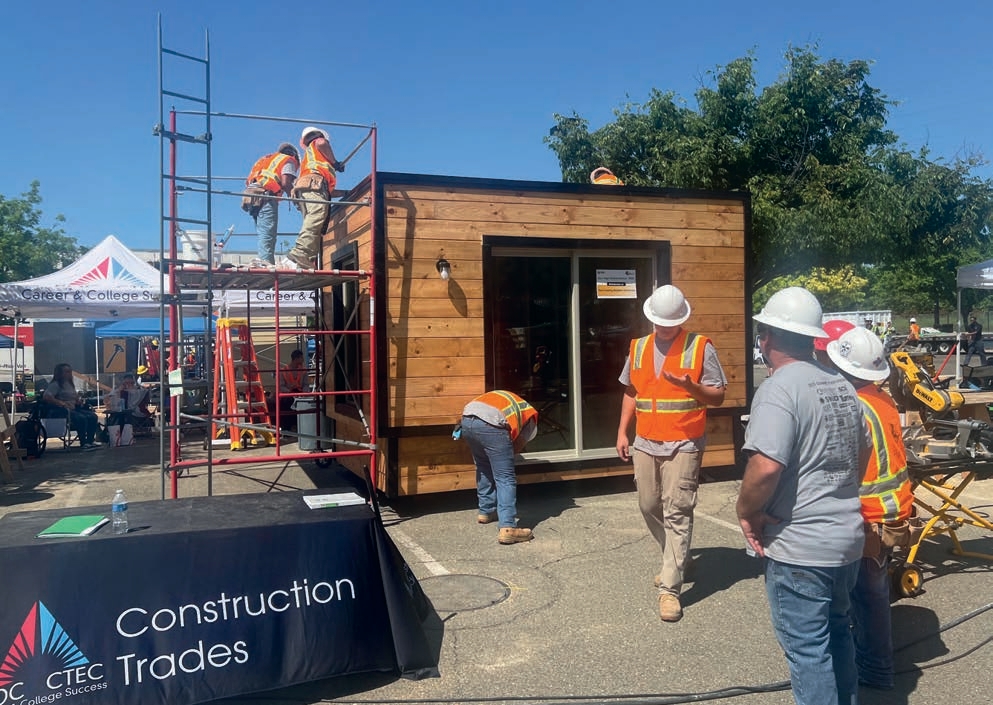
The growth speaks for itself. This year’s Sacramento competition features 42 teams, a far cry from the four high-school teams that gathered behind the Builders’ Exchange 40 years ago. The event has outgrown multiple venues and now takes over an entire junior college parking lot.
Each team consists of seven to 15 students, plus a coach and parent volunteers. Students handle the complete project life cycle, from designing their shed in AutoCAD to assigning a 16-year-old as a dedicated safety lead, to managing the actual construction.
“Everyone receives a standard materials list with a door, window, and electrical connection,” Johnson says. “But what they do with those materials is up to them.”
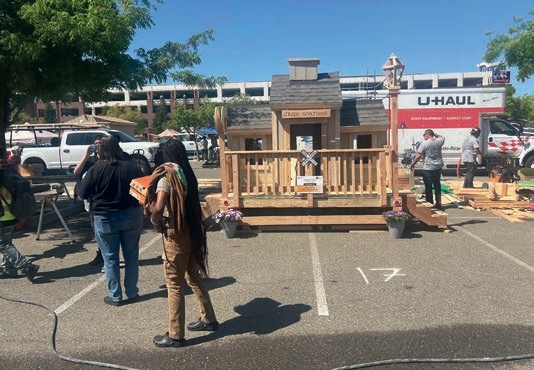
The competition includes multiple categories. Beyond the traditional shed build, teams have created tiny homes, playhouses, greenhouses, and even tank-inspired structures. Projects are judged on safety, completeness, skill, build quality, and design. Notably, speed is not a factor.
“We’re not racing,” Johnson emphasizes. “We’re teaching them to do it right.”
BEYOND SACRAMENTO
The model’s success has sparked expansion acrossthe United States. Similar competitions now run in Oregon, Nevada, Los Angeles, Texas, and Indiana, bringing the total to seven or eight events nationwide. Each follows the Sacramento blueprint, emphasizing safety, skill development, and exposure to the full range of construction careers.
“This shows students viable, exciting career paths beyond just swinging a hammer,” Johnson notes. “They see roles in safety, design, consulting, the whole spectrum of what construction offers.”
INDUSTRY SUPPORT MAKES IT HAPPEN
INDUSTRY SUPPORT MAKES IT HAPPEN The construction industry has rallied behind the
program. Major contractors volunteer professionals to serve as judges, evaluating projects on technical merit and safety protocols. Companies donate materials and expertise.
Johnson’s company, Skyline, provides 50 rolling scaffold towers for each event – 10 x 5 x 7.5 feet tall – allowing students to safely perform tasks like shingling and siding work at height.
“Safety is built into everything we do,” he says. “Having a 16-year-old student designated as the safety lead teaches them that safety isn’t just a box to check, it’s a responsibility and a career path.”
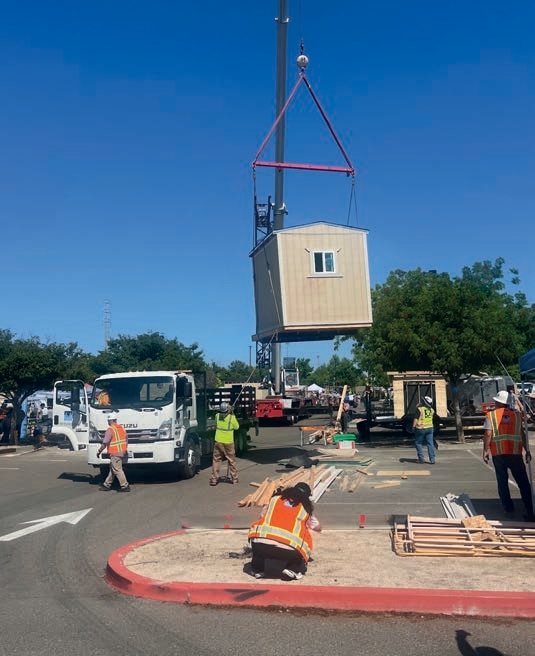
The completed structures serve three main purposes. Many go back to the schools and are raffled off, raising funds for the programs. Schools sometimes keep structures they need, last year, one team’s greenhouse stayed on campus. Other
teams build playhouses that are donated to local elementary schools.
All materials, time, and expertise are donated, making the program accessible to schools regardless of budget constraints.
ADDRESSING THE REAL PROBLEM
For Johnson, the program tackles a fundamental disconnect in how society views education and career paths.
“We’re telling kids who might not be suited for college that they have to go anyway,” he says. “Then they end up in low-wage jobs, barista, retail, that won’t lead to a middle-class life. Meanwhile, we have a massive skilled labor shortage.”
The alternative the program offers is compelling. A journeyman at Johnson’s company earns $120,000 annually with full family benefits. That’s not an outlier; it’s representative of what skilled trades can provide.
“This program shows a path to stability and prosperity,” Johnson explains. “These kids learn they can make a good living, support a family, and take pride in work they can see and touch.”
MORE THAN CARPENTRY
While students learn practical skills like framing, electrical work, and precise measuring and cutting, the program exposes them to the full ecosystem of construction careers. The AutoCAD design phase introduces them to drafting and engineering. The safety planning shows them risk management and compliance. The project management teaches them coordination and scheduling. “A lot of kids don’t realize how many roles exist in construction beyond swinging a hammer,” Johnson says.
“They might not want to be on the tools every day, but they might love being a safety manager or a designer or a consultant. We show them all of it.”
A PERSONAL MISSION
Johnson’s passion for the program is rooted in personal experience. As someone who struggled in traditional academic settings, he found purpose and success working with his hands.
“For some of us, this kind of work can save your life,” he says simply. “I see myself in these kids. The ones who are being told they have to sit still, focus,
go to college – when what they really need is to build something.”
After 17 years of involvement and 40 years of program history, the results validate the approach. Former participants have gone on to successful careers across the construction industry.
Schools continue to expand their participation. And most importantly, young people are discovering that skilled trades offer not just a job, but a future.
“We’re not just building sheds,” Johnson reflects. “We’re building the next generation of the construction workforce. And we’re showing kids who might have felt lost in the traditional system that they have value, they have skills, and they have a future.”
“We’re not just building sheds,” Johnson reflects. “We’re building the next generation of the construction workforce. And we’re showing kids who might have felt lost in the traditional system that they have value, they have skills, and they have a future.”